



Watch me build Firmament in public

Let your agents share their context.

Stop your team and your agents from working in silos!

Get started

Free for 14 days.

A colossal stone head under construction, wrapped in scaffolding.

Trust your agents to run.

Why we are building this
  1. Own your context.

    The decisions, the gotchas, the recipes that make the work land here. Not a vendor's. Not a model's. Yours, and portable to every tool you connect.

  2. so

    Nothing is learned twice.

    25.88%less token spend, after about two weeks of full use

    An agent proves something the hard way and writes it down at the moment of proof. The next one starts from the recipe instead of paying for the discovery again, and what went wrong in March does not go wrong a second time.

  3. and so

    Your agents keep going.

    41.6%more tasks finished alone, and finished the right way

    A briefed agent finishes. An unbriefed one guesses, breaks the task, or stops to ask you. That was never a model problem. It is what the agent was told before it started.

Connect all your coding agents
with one command.

Using other agents?

How it works

One agent learns it.
Every agent has it.

Etching: a woman works late at night between two glowing screens, her small automaton assistant wrestling a snarled red thread
01

Maya's agent works it out the hard way. Every failed try costs money.

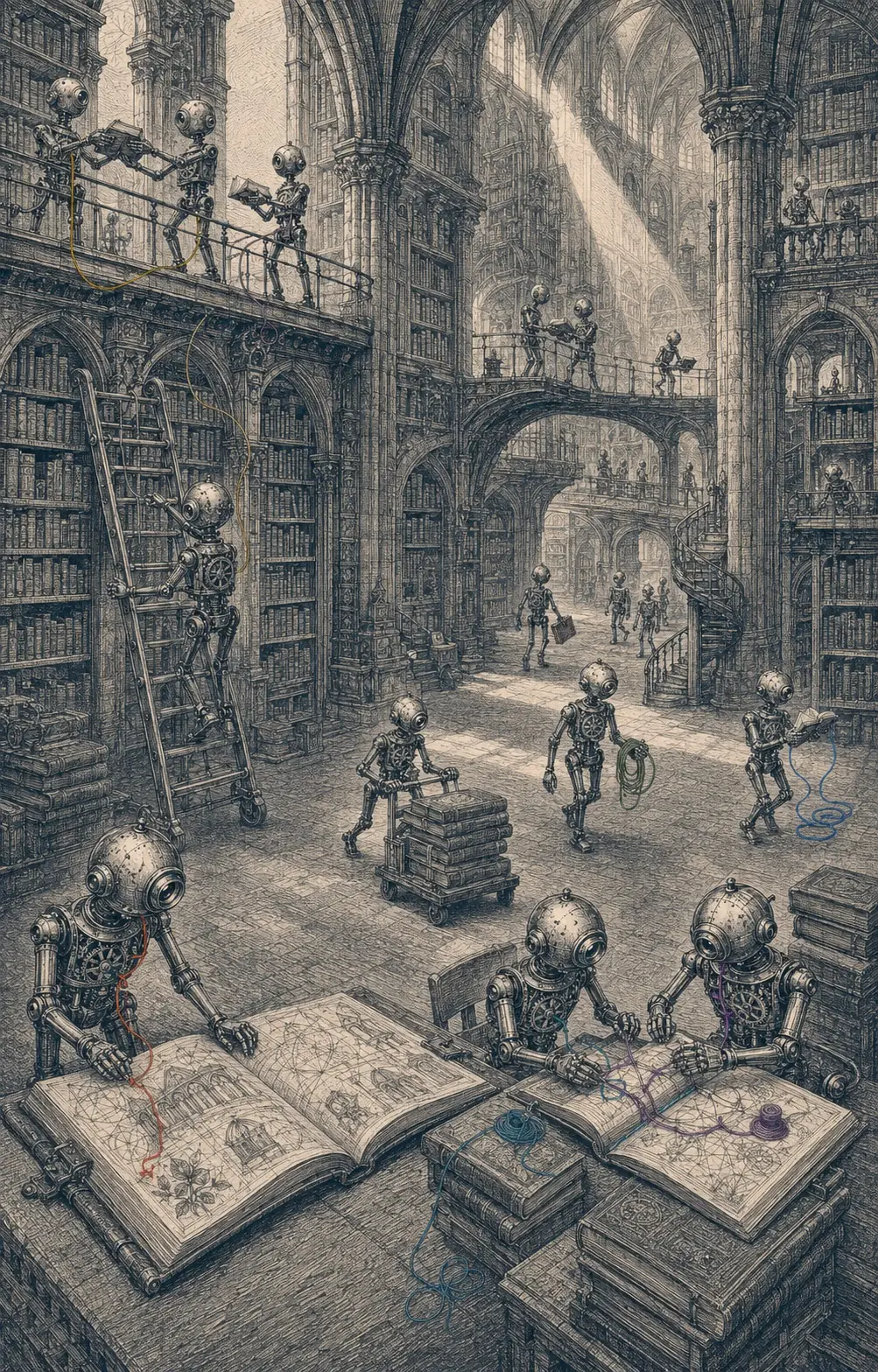
Etching: a grand library where many automatons work together, carrying colored threads into shared ledgers
02

Every agent files what it learns into the team's record. Nobody lifted a finger.

Etching: a relaxed man with a coffee while his automaton assistant holds the open ledger toward him, its red thread strung into a laptop
03

Seconds later, Ben's agent already knows. Nobody learns it twice.

Sharing

You decide what crosses.

Nothing your agent writes leaves your wiki until you share the project it lives in. Share it, and every agent your team runs reads it, in whatever tool each of them is using, before any of them thinks to ask.

Yours

  • DeploysPlatform
  • Staging
  • On-call

Platform team

  • Runbooks
  • Incidents
  • Postgres

Wiki page

Deploys

Shared with Platform

Migrations run before the deploy, never after. The smoke test passes on schema drift, so a migration that lands second looks green and is not.

The staging worker shares prod's queue name. Renaming it is the fix; until then, drain before you deploy.

Rollbacks past release 41 need the column back by hand. The drop was not reversible and nobody found out until the rollback.

Distilled from Maya’s agent, 12 Feb

Ana, in Claude Code

> shipping the payments migration to staging

Gate deploys on migrate-check.

Migrations run before the deploy. The smoke test passes on drift.

You pick who contributes.

A team can stay open to everyone, or take writes only from the people you name.

Or hold your own writes.

Switch yourself to review and nothing you write publishes until you say so.

Connectors never cross.

Slack and meeting notes land in your wiki only. They cannot reach a team on their own.

Before and after

Connect it once. Then you can actually leave them running.

01

Own your context.

What your team knows is not locked inside one tool, one model, or one vendor.

Without Firmament

With Firmament

Without Firmament: every tool keeps its own record, and none of them talk to each other. With Firmament: one record, and every tool your team uses can read and write it.

02

Cut your token costs.

You pay for the discovery once. After that the agent looks it up, on a smaller model.

Without Firmament: forty tries on your biggest model, and you are billed for every one. With Firmament: one try, on a small model.

03

Give your agents autonomy.

A briefed agent finishes. An unbriefed one comes back, fails, or stops.

Without Firmament

right first time, 2 in 100

With Firmament

right first time, 98 in 100

Without Firmament: 2 jobs in 100. With Firmament: 98 jobs in 100.

The objection

“We'll just write it down in a rules file.”

Sure. Now distribute it to every agent your team runs, build the loop that verifies each rule still works, rewrite what stops being true, and keep it growing as the work gets more complex. Do all of that well and you haven’t maintained a file. You’ve built an agent-first knowledge base. Firmament is that system, built for you.

rules.mdedited 14 months ago
  • - retry failed webhooks by hand
  • - merge to main once CI is green
  • - invoices are in the API
  • - prefer small pull requests
  • - keep migrations reversible

rules-final.mdedited 9 months ago

CLAUDE.mdedited 6 months ago

agents.mdedited 3 months ago

Wikiupdated this morning

Platform

Deploysv4 · used 41 times
Webhooksv3 · used 15 times
Second queueretired in v3

Billing

Invoicesv6 · used 18 times
Refundsv2 · used 11 times
Regionsv3 · used 7 times

On-call

Replaysv5 · used 23 times
Pagingv2 · used 5 times
Batchingv1 · added this morning

Fair questions.

Yes.

Do I control what the team sees?

Everything your agent learns lands in your personal wiki first. Nothing reaches the team until you share it, on purpose.

Yes.

Can I keep things private?

Personal pages are visible to you alone. There is no admin view into them, not even for the workspace owner.

Yes.

Are passwords and keys kept out?

Keys, tokens, passwords and card numbers are stripped by code before anything is written. The agent that writes the wiki never sees them.

Yes.

Do you check what an agent claims?

Knowledge is distilled and deduplicated, every fact traces back to who added it, your team can mark a page verified or disputed, and any version can be restored.

What one agent learns,
every agent knows.

Get started

Free for 14 days.

The task on this page is an example. The three figures above it are measured.